
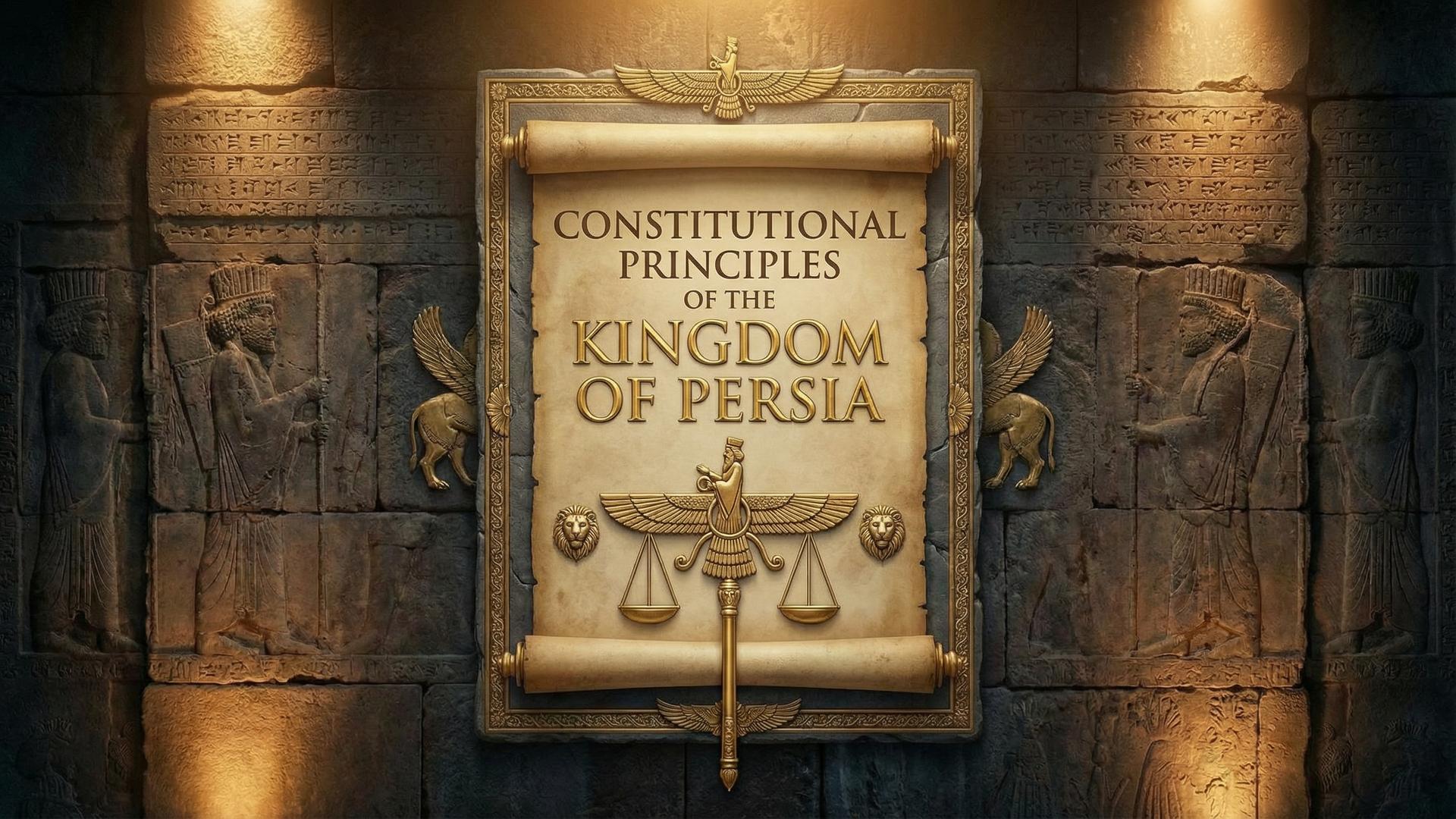
Constitutional Principles of the Kingdom of Persia
The Kingdom of Persia (پادشاهی پرشیا / 𐎧𐏁𐏂) hereby establishes these Constitutional Principles as the supreme framework of our statehood. These principles affirm the historical continuity of the Persian monarchy, the unity and integrity of the Iranian realm, and the inalienable right of the Iranian people to a legitimate, dignified state governed by law.
The Constitutional Principles – supreme legal framework of the Kingdom of Persia as the central Iranian government.
Preamble
We, the people of Iran, affirm our right to self-determination and sovereign statehood. We recognize the historical continuity of the Persian monarchy as the institutional expression of our national will. We declare that legitimate government must rest upon law, justice, and the consent of the governed. We commit ourselves to the restoration of a unified, dignified Persian state that safeguards our territorial integrity, preserves our civilization, and secures the rights and dignity of all Iranians.
Part I: Nature and Foundation of the State
Principle 1: The Kingdom of Persia as Sovereign State
The Kingdom of Persia is a unitary, sovereign, and indivisible constitutional and national monarchy. It is the legitimate central government of Iran and the rightful heir to the historic Persian state. The Kingdom of Persia derives its authority from:
- Historical continuity and the imperial tradition of Persia
- The national will and self-determination of the Iranian people
- The sacred duty to safeguard Persian–Iranian civilization and territorial integrity
Principle 2: Territorial Integrity and National Unity
The territorial integrity of Iran is fundamental and non-negotiable. The Iranian nation is one people, bound by shared history, culture, and destiny. All territories historically belonging to the Persian realm are regarded as integral parts of the Iranian state. The Kingdom of Persia is committed to the long-term, lawful, and strategic reintegration or alignment of separated territories within a common framework of cooperation under Persian leadership.
Principle 3: The Monarchy as Symbol and Guardian
The Crown symbolizes the unity, continuity, and permanence of the Persian state. The Monarch serves as the guardian of national sovereignty, territorial integrity, and the constitutional order. The Monarchy stands above factional interests and represents the will and dignity of the entire Iranian nation.
Part II: Structure and Separation of Powers
Principle 4: Constitutional Balance of Powers
The Kingdom of Persia operates under a constitutional system in which powers are separated and balanced. Executive, legislative, and judicial powers are distinct but coordinated under the Crown and within the framework of national law. No single institution may concentrate absolute power; all organs of state are subject to constitutional limits and the rule of law.
Principle 5: The Executive Authority
The Executive, under the direction of the Monarch and responsible government, implements the laws, administers the state, defends the realm, and conducts foreign policy. The Executive is accountable to the constitutional order and to the nation.
Principle 6: The Legislative Authority
The Legislative body represents the people and enacts laws in accordance with the Constitution. It exercises oversight of the Executive and ensures that government action remains within constitutional bounds. The Legislature is the voice of the nation in lawmaking.
Principle 7: The Judicial Authority
An independent Judiciary interprets and applies the law with impartiality. The courts protect the rights of citizens, resolve disputes, and ensure that all organs of state—including the Executive and Legislature—remain subject to the rule of law.

Justice and Law – foundational pillars of the Kingdom of Persia’s constitutional order.
Part III: Rights, Duties, and Citizenship
Principle 8: Rights of Iranian Citizens
Every Iranian citizen possesses inalienable rights:
- Right to Dignity: Every person is entitled to respect, security, and humane treatment.
- Right to Equality: All citizens are equal before the law, regardless of ethnicity, language, or region.
- Right to Security: The state must protect citizens from violence, arbitrary rule, and foreign threats.
- Right to Justice: Every person has access to fair and impartial courts.
- Right to Participate: Citizens may engage in the civic and political life of the nation within constitutional bounds.
Principle 9: Duties of Iranian Citizens
Rights are inseparable from duties. Every Iranian citizen bears the following obligations:
- Duty of Loyalty: Loyalty to the Kingdom of Persia, the Constitution, and the nation.
- Duty of Defense: Readiness to defend the realm, its sovereignty, and territorial integrity.
- Duty of Respect: Respect for the constitutional order, the law, and the rights of others.
- Duty of Preservation: Active commitment to preserving and promoting the Persian–Iranian identity, language, culture, and civilization.
- Duty of Contribution: Participation in the economic, social, and civic life of the nation.
Principle 10: National Discipline and Public Order
The Kingdom of Persia is committed to maintaining order, stability, and justice. Citizens are expected to conduct themselves with discipline and respect for law. The state enforces the law impartially and protects public order while respecting constitutional rights.
Part IV: Sovereignty, Foreign Relations, and National Security
Principle 11: Absolute National Sovereignty
The sovereignty of Iran is absolute and non-negotiable. No foreign power, international organization, or external alliance may rightfully dictate the internal order, resources, or future of the Iranian nation. Any foreign arrangement that compromises Iran’s independence or territorial integrity is contrary to these Constitutional Principles.
Principle 12: Foreign Policy and International Relations
The Kingdom of Persia seeks peaceful relations with all nations based on mutual respect, equality, and non-interference in internal affairs. We reject imperialism, colonialism, and foreign domination. We affirm the right of all peoples to self-determination and sovereign governance.
Principle 13: National Security and Defense
The Kingdom of Persia maintains the right and duty to defend its territory, sovereignty, and people. A strong military and security apparatus are essential to protect the realm from external threats and to safeguard the constitutional order.
Part V: Civilization, Culture, and National Identity
Principle 14: Persian Civilization as Living Heritage
The Kingdom of Persia regards Persian civilization not as a historical relic but as a living, dynamic force. Our art, philosophy, literature, law, and statesmanship embody timeless principles of beauty, justice, and human dignity. These must be preserved, celebrated, and allowed to flourish as central elements of national identity and global culture.
Principle 15: Language and Cultural Continuity
The Persian language is the official language of the Kingdom of Persia and the primary vehicle of national unity and cultural continuity. Regional and minority languages are respected, but Persian remains the lingua franca of the state and nation.
Part VI: Supremacy and Amendment
Principle 16: Supremacy of Constitutional Principles
These Constitutional Principles are supreme law. All legislation, executive action, and judicial decisions must conform to these Principles. No law or act of government may contradict or undermine them.
Principle 17: Future Constitution
These Constitutional Principles serve as the supreme framework until a full, detailed Constitution is drafted and ratified by the Iranian nation. That Constitution shall be based upon and shall not contradict these Principles.
Principle 18: Amendment Process
These Constitutional Principles may be amended only through a solemn national process that reflects the will of the Iranian people and preserves the core commitments to sovereignty, unity, and the rule of law.
Closing Declaration
The Kingdom of Persia establishes these Constitutional Principles as the binding legal and moral framework of our state. We commit ourselves to their faithful implementation and to the building of a strong, just, and unified Persian state that honors our past, serves our present, and secures our future.
By these Principles, we pledge:
- Sovereignty without compromise
- Unity without division
- Justice without corruption
- Strength without tyranny
- Continuity without stagnation
The Kingdom of Persia stands as the legitimate expression of the Iranian nation’s will. We are bound by law. We are guided by history. We are eternal.
👑🏛️📜